Cricket has a fine tradition of putting great names on the silverware. Australia and India contest the Border–Gavaskar Trophy, honouring two batting giants who led their countries with distinction. England and West Indies play for the Richards–Botham Trophy, named after men who were close friends at Somerset but fierce rivals in Test cricket. Sri Lanka and Australia compete for the Warne–Murali Trophy, celebrating the two greatest spinners the game has known.
Which raises an interesting question: if Sri Lanka and Pakistan were to play for a trophy, whose name should it bear?
An Imran–Arjuna Trophy has an obvious appeal. Here were two formidable leaders who took their countries to World Cup glory. Others might favour a Miandad–de Silva Trophy, honouring perhaps the finest batsmen the two nations have produced.
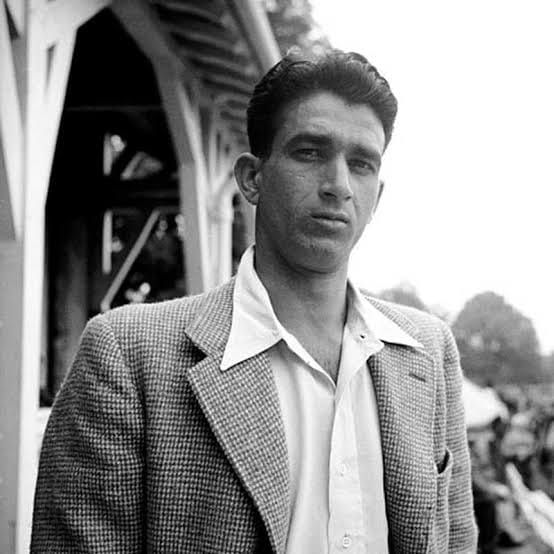
But there is another name deserving of consideration: Abdul Hafeez Kardar.
He was Pakistani, of course, but Sri Lankan cricket has ample reason to salute him. Few men outside the island did more to champion its cause when a place at cricket’s top table remained frustratingly out of reach.
“He was a visionary leader. He aggressively pushed Sri Lanka’s cause for Test status in the 1970s. He was confident that our cricket was strong enough to compete at the highest level,” Chandra Schaffter, the oldest living Sri Lankan cricketer at 96, told The Cricket Scribe.
To appreciate why Kardar’s voice carried such weight, it is worth going back to the beginning.
He first played Test cricket for India, before Partition. Just 21 when he made his debut at Lord’s in 1946, he shared a dressing room with Vijay Merchant, Vijay Hazare, Lala Amarnath and Vinoo Mankad.
Six years later, when Pakistan entered Test cricket, Kardar was entrusted with leading the newcomers.
He had hardly spent the intervening years marking time. He studied philosophy, politics and economics at Oxford, represented the university and played county cricket for Warwickshire. His connections with the county extended beyond the boundary: he married Helen Rosemary Hastilow, daughter of Warwickshire chairman Cyril Hastilow.
For a fledgling cricket nation, a captain who knew his way around both a dressing room and the corridors of power was worth his weight in gold. Kardar had the contacts and diplomatic touch to open doors that might otherwise have remained firmly shut.
Little wonder he came to be regarded as the father of Pakistan cricket.
Nor was his influence confined to committee rooms. In the 23 Tests he captained, Pakistan recorded a victory against every opponent they faced. The newcomers were soon making themselves heard.
After retirement, Kardar served as Pakistan’s chief selector and later its cricket board president, bringing the same force of personality to administration.
He advocated neutral umpires long before the idea became accepted practice, challenged the veto power enjoyed by England and Australia at the ICC and argued strongly for Asian solidarity. The Asian Cricket Council would emerge a few years after he quit the Pakistan board in protest at political interference.
Imran Khan summed up the great man thus; After Kardar’s retirement, Pakistan cricket was thrown to the wolves.”
For Sri Lanka, Kardar’s support was practical as well as political. He understood that arguing for Test status meant little unless opportunities were also created to prepare a team for it.
“Kardar constantly sent Pakistan teams to Sri Lanka to play unofficial Test matches and we went to Pakistan regularly. He then arranged opportunities for our coaches to be trained in Pakistan. He also sent experts to train our curators and set up the Ali Bhutto Trophy between the under-19 sides of our two countries. His contribution to Sri Lankan cricket was immense,” Schaffter added.
Sri Lanka finally gained Test status in 1981 and played their inaugural Test the following year. Kardar had every reason to be delighted.
Then came a fitting final chapter. In March 1996, Sri Lanka lifted the World Cup in Lahore, his home city. A month later, Kardar died.
A trophy bearing his name would honour Pakistan’s founding captain and a steadfast friend of Sri Lankan cricket. The two countries would have much to celebrate each time they played for it.